

Google Analytics Alternative
Radar Analytics (Radar) counts pages, not people. Every site we host runs it, and it answers the questions you would ask Google Analytics – how many people came, which pages they read, where they arrived from – without collecting anything about the person doing the visiting.
In the wake of all the news about privacy and website lawsuits, you may be asking yourself:
- Do I have to put a cookie banner on my website?
- Is my site collecting information about visitors that I don't know about?
- What are these website lawsuits actually about, and does my site have exposure?
- Can I see how many people visit my site without tracking them?
- Will my traffic numbers look worse if I stop using Google Analytics?
- Will it slow my site down?
- Who else can see the data my website collects?
Every one of those has an answer below.
Do I have to put a cookie banner on my website?
Banners exist for two reasons: something is being stored on the visitor's device, or a person is being identified. Radar does neither. It sets no cookies, keeps no visitor ID, and records no IP address, so there is nothing to ask your visitors to agree to. A site running only Radar has nothing to interrupt them with.
That answer covers our analytics. If your pages also load marketing pixels, a chat widget, or session recording, those identify people and carry their own obligations. We will tell you what is actually on your site.
Is my site collecting information about visitors that I don't know about?
Often, yes, and it is rarely anyone's decision. Scripts get added by a template, a plugin, or a marketing campaign that ended years ago, and nobody ever takes them back out. The only way to know is to look at what the page actually asks for and who receives it.
We do that as part of a site review. Ask us, and you will get a straight answer about what your pages load and where that information goes.
What are these website lawsuits actually about, and does my site have exposure?
The wave of claims filed in California under the Invasion of Privacy Act targets third-party code that captures what a visitor does. Session replay that records clicks and keystrokes. Chat widgets that read the page. Advertising pixels that assemble an identity. Analytics that ships visitor details off to someone else's servers.
What those have in common is a third party receiving information about a visitor who never agreed to it. Radar is first-party, stores nothing about the person, and sends nothing to anyone else. That is the exposure it does not create.
We are web developers, not lawyers. If you want a legal opinion about your own site, that is a conversation for your attorney, and we are happy to answer their technical questions.
Can I see how many people visit my site without tracking them?
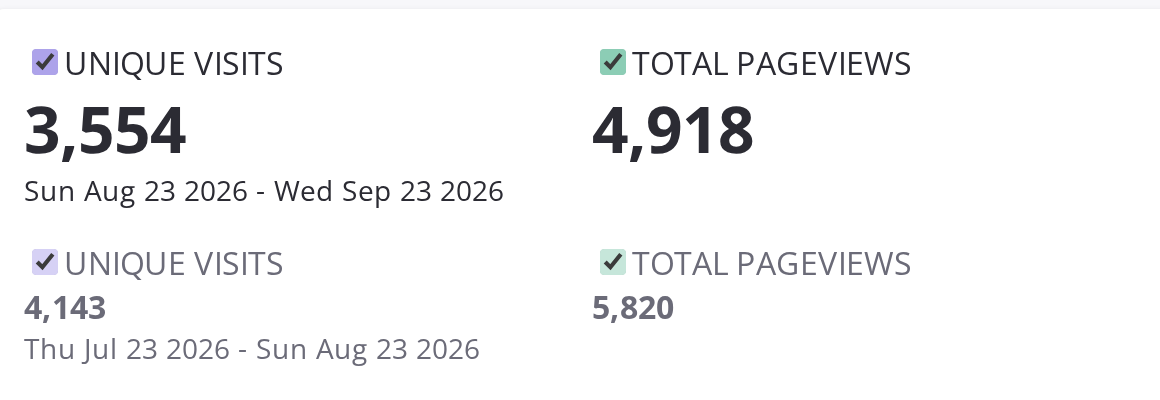
Yes, and the numbers are real. Each day we record counts: which page, how many times, which region it was served from, roughly which kind of device, and what page referred it. That is the whole record. There is no name attached, no profile to build, and nothing to lose in a breach.
The report above is our own site's traffic, August 23 to September 23, 2026. Traffic history runs back to April 2023 and stays, with no sampling and no thresholds that hide small numbers. If you want a report we do not already show, we build it; we run the whole pipeline from the page to the dashboard.
Will my traffic numbers look worse if I stop using Google Analytics?
They will change, because they are counted differently, and we would rather tell you that up front than have you find out later.
Radar works from a small script on the page. A visitor who blocks scripts, or browses with JavaScript off, will not appear in them at all. Google's tag has that same limit on top of whatever consent choices cost it.
What you get instead is a number nobody has an incentive to inflate, and a clear answer to the only question that matters for most pages: is anyone reading this? What we cannot do, and will not claim, is report on a named individual or reconstruct a single person's visit. Nothing in the system records a person, so that report cannot be built. If a vendor offers you one, ask them what else they are keeping.
Will it slow my site down?
No. The script is 274 bytes, it is served from our own server rather than an advertising network's, and it waits until three seconds after the page has finished loading, so it never competes with rendering or layout.
For comparison, the Google tag is about 152 KB fetched from Google before it can do anything at all. Both figures measured September 25, 2026.
Who else can see the data my website collects?
Nobody. It lands in our database and stays there. It is not shared with an advertising network, not used to build audiences, and not sold. We rent servers and a database from AWS the same way any business rents an office; hosting is not the same as having a business model built on your visitors.
You do not have to take our word for any of it. The script that runs on your pages is short enough to read in a minute, and it is not minified or obfuscated. You can fetch it yourself:
code.a8b.co/js/radar.mjs (Opens in new window)
If you would like to know what your site is collecting today, or what Radar Analytics would show you instead, get in touch. It is included with our web presence hosting.